
Woven interlining needs pre-shrinkage testing when it will face heat, moisture, washing or finishing that could change its size, and before you commit it to bulk production. Not every roll behaves the same way. The result depends on the interlining, your outer fabric, your garment process and your finishing method.
That is why we suggest a small sample test early, not a surprise after cutting. This guide explains what the test is, when to run it, what affects the outcome and how to do it. We wrote it for garment, suit, blazer and uniform manufacturers, exporters, sourcing teams and production managers.
What Is Pre-Shrinkage Testing for Woven Interlining?
Pre-shrinkage testing measures how much an interlining sample changes size after the process it will meet in production. You run it before bulk work, so dimensional problems show up on a small sample, not on finished garments.
Dimensional stability is a material’s ability to hold its size and shape. When interlining and outer fabric change size by different amounts, the bonded area can pucker, ripple or distort.
Several factors shape the result:
- Fabric construction: How the base fabric is built and finished.
- Garment construction: Where the interlining sits and how much area it covers.
- Processing conditions: The heat, moisture and pressure it meets.
- Finishing methods: Garment washing, steaming, pressing or dry cleaning.
- Outer fabric compatibility: How the interlining and the outer cloth move together.
- Bulk production risk: A size change caught on a sample costs minutes. The same change found after bulk fusing can affect whole lots.
General industry guidance: shrinkage is not a universal trait of woven fusible interlining. Behaviour depends on the base fabric, the coating and the conditions the material meets. Treat each material and process combination as its own question, and do not carry one result across to another.
When Should Woven Interlining Be Tested for Shrinkage?
Test when something changes or when the cost of a surprise is high. You do not need to test every roll every time.
These situations call for a test:
- New interlining batches: Confirm the new lot behaves like the one you approved.
- New outer fabrics: A different fibre, weave or finish can change how the pair behaves.
- Changes in garment construction: A new pattern or fusing area changes the exposure.
- Different finishing or processing methods: Adding a wash, steam step or different press changes the conditions.
- High-volume production: Small dimensional shifts multiply across thousands of pieces.
- New suppliers or material specifications: A new source or spec is a new unknown.
- Dimension-critical garments: Fitted formal wear, matched panels and uniforms leave little room for drift.
Test before bulk cutting and fusing, because bonding cannot be reversed. A sample test shows potential change while you can still adjust the material, the process or the pattern.
Use this decision path:
Bulk production decision: Approve, adjust or change the material.uitable grade, confirm the result on your own fabric.
Interlining application: Where will it be used?
Production process: Which steps will it go through?
Potential shrinkage exposure: Which of those steps involve heat, moisture or washing?
Sample testing: Run the test on a representative sample.
Dimensional change: Measure and calculate the change.
Outer fabric compatibility: Check that the fused pair stays flat and stable.
What Factors Can Affect Woven Interlining Shrinkage?
Shrinkage depends on the material, the process and the outer fabric together. No single factor decides it.
- Fabric construction: Yarn structure and base fabric finishing influence stability.
- Composition: Where you know the fibre content, check it, because different fibres react differently to heat and moisture.
- GSM or fabric weight: GSM describes weight. It does not predict dimensional change, so do not assume heavier or lighter grades behave a certain way.
- Heat exposure: Fusing, pressing and steaming all add heat.
- Moisture: Steam, humidity and wetting can affect size.
- Washing or finishing: Garment washing and dry cleaning expose the bond and the fabric.
- Fusing conditions: Temperature, time and pressure all matter.
- Outer fabric characteristics: Fibre, weave and stretch change how the outer cloth moves.
- Garment construction: Fusing direction, panel size and seam placement affect how change shows up.
Compare like with like. A result from one woven interlining grade does not transfer automatically to another grade, another outer fabric or another process.
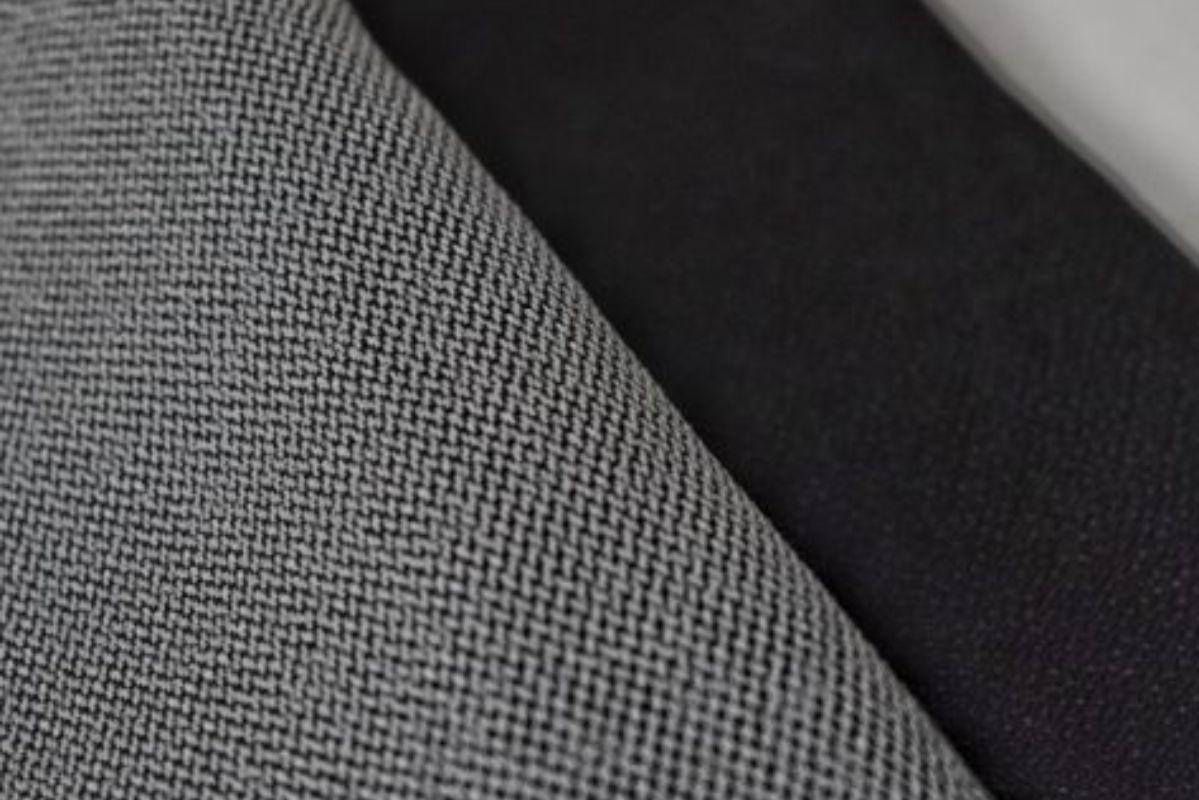
How Should Garment Manufacturers Conduct a Pre-Shrinkage Test?
Take a representative sample, measure it, expose it to your real process, measure again and compare. The steps below are a simple general approach, not a laboratory standard.
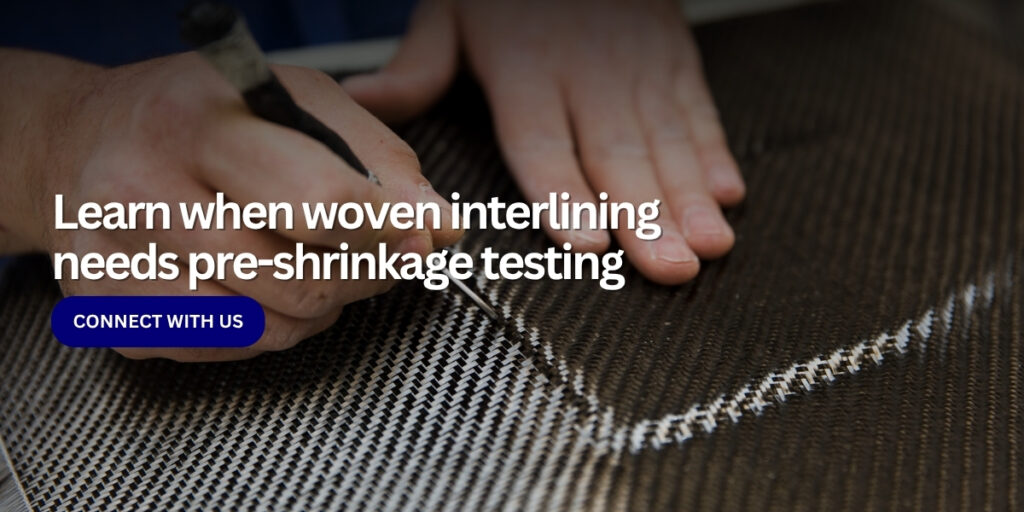
- Take a representative sample. Cut it from the actual batch you plan to use, and cut matching outer fabric from the actual lot.
- Mark the dimensions. Draw clear reference points in both the length and width directions.
- Record the original measurements. Note them before any processing.
- Expose the sample to your process. Fuse, press, wash or finish it exactly as production will.
- Let it settle. Allow it to cool fully before you handle it.
- Measure again. Use the same reference points and the same method.
- Calculate dimensional change. Use this formula: (original − final) ÷ original × 100. Record the direction, whether the sample got shorter or longer.
- Compare with your production requirements. Decide whether the change is acceptable for your garment.
Make the test conditions reflect your actual process wherever possible. We do not give universal temperatures, durations or limits here, because the right ones depend on your material, your press and your garment. Test the interlining alone and the fused pair together, since the pair is what your garment will actually be.
For a closer look at trial fusing, read our guide on what a fusing test involves.
What Should Buyers Check Before Using Woven Interlining in Bulk Production?
Check how the interlining behaves in your process, not just what the spec sheet says. A spec sheet describes the material. Your production line decides the result.
| Check | What to confirm |
| Dimensional stability | Sample test results on your own process |
| Fabric construction | Base fabric structure and composition |
| GSM | The weight you specified, as one input among many |
| Width | Usable width suits your marker and cutting plan |
| Coating | Adhesive type and pattern match your fusing setup |
| Bonding requirements | Bond holds after your finishing and cleaning steps |
| Outer fabric compatibility | The fused pair lies flat with no rippling or puckering |
| Processing conditions | Test conditions match your production conditions |
| Batch consistency | Each new batch matches your approved sample |
| Sample testing | A tested sample is on record before bulk approval |
| Production requirements | Results meet your garment’s dimensional tolerance |
Specifications set expectations, but they cannot replace your test. The same material can behave differently on different fabrics, presses and finishing routes.
Buyer recommendation: Keep a swatch of the tested, approved lot. Compare every new batch against that reference before you release it to the line. Share your process details with your supplier too, so you can compare offers on the same basis.
Woven Fusible Interlining From Double Ghoda
We are B.C. Impex, an import and trading business, and we supply woven fusible interlining in 11 GSM grades from 30 to 150.
| Detail | Specification |
| Structure | Woven, polyester yarns in warp and weft |
| Material | 100% polyester |
| Coating | PA double-dot (polyamide scatter coating) |
| Weight range | 30 to 150 GSM, 11 grades |
| Width | 150 cm (58–60 inches) |
| Roll length | 50 metres per roll, 6 rolls per bale |
| Colours | White, black, grey/charcoal |
| Care | Machine wash at 40°C, dry-clean safe |
| Certification | OEKO-TEX® Standard 100 |
The 11 grades are 30, 42, 55, 60, 70, 80, 100, 120, 130, 140 and 150 GSM. Our 140 GSM grade, known in the trade as 111 quality, is our flagship for full-front sherwani construction. We also supply 100 GSM for structured suits, 120 GSM for premium suits, blazers and bandgala jackets, and 80 GSM for standard blazers and jackets.
How this connects to your test. Our fusing conditions are 125–145°C, 18–25 seconds and 1.5–2.5 kg/cm². Use them as a reference point, then run your sample at the conditions your line actually uses. Your press and outer fabric decide the final settings.
Before a lot goes into our stock, our inspections cover white shade consistency, colour stability, shrinkage control and PA bonding strength. We do not describe any grade as shrinkage-free or pre-shrunk, and these checks do not replace a test on your own outer fabric and process.
Tell us your garment type, outer fabric and finishing route, and we will help you shortlist grades to sample. You can view the complete grade range for full details.
Frequently Asked Questions
What is pre-shrinkage testing for interlining?
It is a small sample test that measures how much interlining changes size after your production process. You run it before bulk work to catch dimensional problems early.
Does interlining shrink during garment production?
It can, but it is not universal. Change depends on the material, the outer fabric and exposure to heat, moisture, washing or finishing. A sample test shows what happens in your process.
When should interlining be tested for shrinkage?
Test it for new batches, new outer fabrics, changed garment construction, new finishing methods, high-volume runs, new suppliers and dimension-critical garments. Always test before bulk cutting and fusing.
How do you test interlining for dimensional stability?
Mark and measure a representative sample, expose it to your actual process, let it cool, then measure again. Calculate the change as (original − final) ÷ original × 100 and compare it with your requirements.
Does GSM affect interlining shrinkage?
GSM describes weight, not shrinkage behaviour. Do not assume a heavier or lighter grade will change more or less. Test each grade with your outer fabric and process.
What interlining options does Double Ghoda supply for suits and blazers?
We supply woven polyester grades from 30 to 150 GSM with PA double-dot coating, in a 150 cm width and 50-metre rolls. The range includes 80 GSM for standard blazers, 100 GSM for structured suits and 120 GSM for premium suits and blazers.
Your framework: start with your outer fabric’s weight, then consider its construction, your garment type and section, and the structure and finish you want. Shortlist one or two grades from our range, then test them on your own fabric and press before you commit to a bulk order. Following this chain keeps your choice tied to the whole garment, not a single number.
Link of related Articles
- Lightweight Interlining vs. Heavyweight Interlining
- A Beginner’s Guide to Interlining
- Choosing the Right Interlining