
Switching interlining suppliers is never a decision you take lightly. When your production runs hundreds of collars, cuffs, and shirt plackets a week, any inconsistency in your interlining, wrong GSM, uneven coating, short rolls, shows up immediately in your finished garments and your reject rate.
If you are evaluating Non woven interlining suppliers in India, for non-woven supply, you need a clear checklist, not a sales pitch. This blog gives you the six things that actually matter when assessing a non-woven interlining supplier, what to look for in each, and what poor quality looks like before it becomes a production problem.
At Double Ghoda, these are the same standards we hold ourselves to, and the same questions our buyers ask us before placing their first order.
Table of Contents
- Check the GSM Range and Application Suitability
- Check the Adhesive Coating and Bonding Performance
- Check Roll Length and Width Consistency
- Check Certifications and Compliance Documentation
- Check Batch-to-Batch Consistency
- Check Technical Expertise and Application Support
Check the GSM Range and Application Suitability
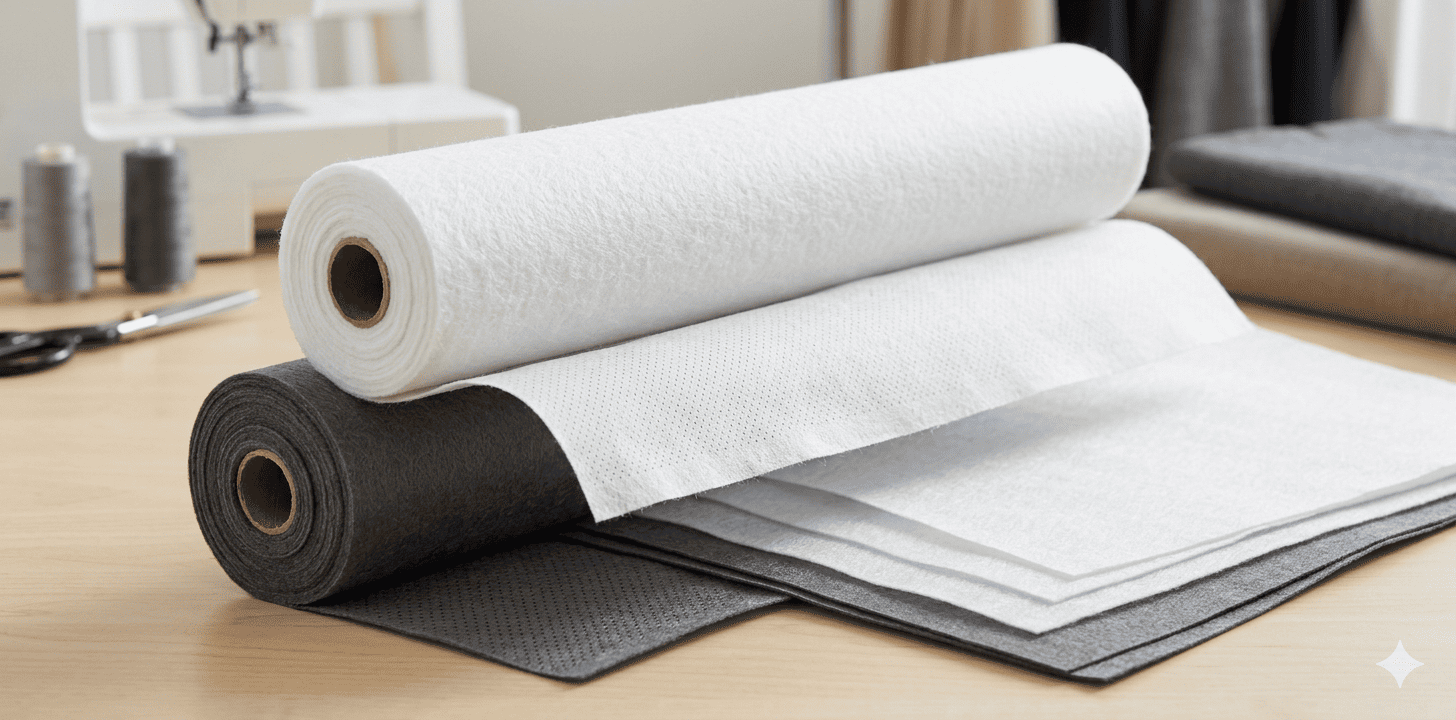
The first thing to verify with any non woven fusible interlining supplier is whether their GSM range actually covers your production requirements, and whether the stated GSM matches the actual product weight.
Why GSM range matters
Non-woven interlining serves different applications at different GSM levels. Your supplier needs to cover your full non-woven requirement, from light shirt placket reinforcement at the lower end to medium-structured front fuse on light jackets at the upper end. A supplier who only stocks a narrow GSM range forces you to split your sourcing across multiple vendors, which introduces quality variability and procurement complexity.
Our non woven fusible interlining range covers 30 GSM to 82 GSM, the full spectrum of non-woven applications for Indian garment manufacturing. Here is how that range maps to your production:
| GSM Range | Application |
| 30–45 GSM | Shirt plackets, light facings, very light reinforcement |
| 45–65 GSM | Shirt collars, collar stands, cuffs |
| 65–82 GSM | Light jacket fronts, women’s structured garments, medium reinforcement |
How to verify GSM accuracy
Do not rely on the supplier’s stated GSM alone. Cut a 10cm × 10cm swatch from a roll and weigh it on a precision scale. Multiply the weight in grams by 100, this gives you the GSM. If the result deviates from the stated GSM by more than 5%, the product is not to specification. A supplier who consistently delivers accurate GSM controls their production process. One who does not is one whose quality you cannot plan around, and that uncertainty costs your production.
What poor GSM accuracy looks like in your production:
- Fusing parameters that work on one batch but not the next, because the actual GSM is shifting between rolls
- Collar interlining that feels too stiff or too soft for the outer fabric weight
- Inconsistent structure across garments in the same production run
Check the Adhesive Coating and Bonding Performance
The coating is what makes non-woven interlining fusible, and it is the most variable element you will encounter across suppliers. It is also the hardest to assess without testing, which is why most buyers skip it and pay the price later.
What to look for
Our non woven interlining uses PES (Polyester) adhesive applied through paste dot and double dot coating. This is the correct coating for non-woven applications, it activates cleanly at the correct fusing parameters, bonds consistently across the full surface, and holds through washing at 40°C and dry cleaning.
When evaluating a supplier’s coating quality, check four things:
Dot uniformity — hold the interlining up to a light source. The adhesive dots should be evenly distributed across the full width of the fabric. No bare patches, no dense clusters, consistent pattern from edge to edge. Uneven dots mean uneven bonding, soft spots on your collar or cuff that will show up after the first wash.
Activation at correct temperature — fuse a sample at the correct parameters for non-woven:
| Press Type | Temperature | Pressure | Time |
| Flat-bed press | 130°C – 150°C | 0.8 – 2.0 kg/cm² | 12 – 16 seconds |
| Continual press | 125°C – 140°C | 1.0 – 2.0 kg/cm² | 12 – 18 seconds |
If the bond requires temperatures outside this range to activate properly, either much higher or much lower, the coating adhesive is not the correct specification.
No strike-back — after fusing, check the face side of your outer fabric. There should be no adhesive bleed-through to the visible surface. Strike-back is a permanent defect, it cannot be corrected after fusing and results in a reject.
Bond strength after washing — fuse a test piece, wash it at 40°C, and attempt to separate the layers. When we supply non-woven interlining, your fused pieces should hold cleanly through washing at 40°C without any separation. If the bond weakens or releases after one wash, the PES coating is either too light, incorrectly applied, or the wrong adhesive type for the product.
Check Roll Length and Width Consistency
Roll length accuracy is one of the most overlooked checks when you are evaluating suppliers, and one of the most impactful on your production economics.
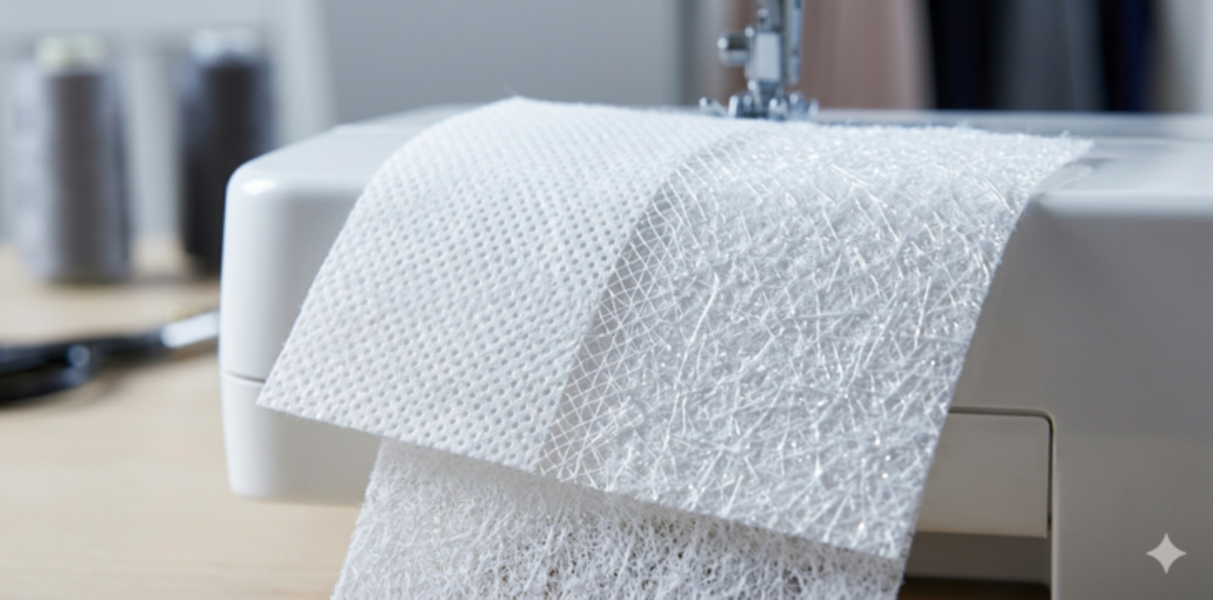
Our non woven interlining fabric is packed in 100-yard rolls, 6 rolls per bale. This is the standard packing for non-woven interlining in the Indian wholesale market. Each roll should measure the stated 100 yards, not 95, not 97. Short rolls are a known and common problem with lower-quality suppliers, and the impact compounds quickly.
The economics of short rolls
If each roll in a 6-roll bale is 2 yards short, you lose 12 yards per bale. Across 10 bales, 1,000 metres roughly, that is approximately 110 metres of material you paid for and did not receive. At any realistic per-metre price, that is a significant loss per order. Across a full production season, it becomes a meaningful margin erosion.
How to verify roll length
Measure the first few rolls of any new shipment from a new supplier. You do not need to measure every roll, but measuring three to five from the first bale tells you whether the supplier holds to their stated length consistently. If the first bale is accurate, spot-check subsequent deliveries. If the first bale is short, reject the shipment and raise it with the supplier before the second order.
What accurate packing signals about a supplier
A supplier who consistently delivers accurate roll lengths is a supplier who controls their production and packing process. Short rolls are almost never accidental at scale, they point to either poor process control or deliberate under-supply. Either way, it tells you something important about who you are working with.
Width consistency
Our non-woven interlining is 100 cm (40 inches) wide. Width should be consistent across the full roll, not narrower at the edges, not variable from roll to roll. Width variation creates cutting waste when your cutting team has to accommodate an inconsistent edge, and affects your panel dimensions if pieces are cut from different widths.
Check Certifications and Compliance Documentation
If your garments go to brands, retail chains, or export markets, your interlining inputs need to meet their compliance requirements. This is not optional, it is increasingly the first thing your buyers specify before placing orders with you.
Our non woven interlining fabric carries OEKO-TEX Standard 100 certification. This confirms the product has been independently tested and verified to be free from harmful substances, across every component of the product, including the base fabric, the adhesive coating, and any dyes or finishing agents used in production.
Why OEKO-TEX matters for your production
If your customer, a garment brand, a retail chain, or an export buyer, specifies OEKO-TEX certified inputs, you need certification from every material supplier in your chain, including your interlining supplier. If your supplier cannot provide current certification documentation, you cannot use their products in your certified supply chain, and that puts your own compliance at risk.
What to ask a supplier:
- Do you hold current OEKO-TEX Standard 100 certification for this specific product?
- Can you provide the certificate number for verification?
- Does the certification cover the adhesive coating as well as the base fabric?
Legitimate certification covers the complete product, base fabric and coating together. If your supplier offers certification for the base fabric only, or cannot provide a certificate number you can verify independently, treat that as a red flag.
Beyond OEKO-TEX
Depending on your export markets, you may also need to verify compliance with REACH regulations (for EU markets), Oeko-Tex MADE IN GREEN, or buyer-specific chemical restriction lists. Ask us or any supplier you are evaluating whether they have documentation for these requirements before you commit.
Check Batch-to-Batch Consistency
This is the check that separates a reliable long-term supply relationship from one that looks good on the first order and creates problems on the second.
Batch-to-batch consistency means that the GSM, coating quality, width, colour, and bond performance of your non woven interlining is the same across every order you place, not just across the first batch. For your production unit running continuous garment output, this is non-negotiable. Variation between batches creates quality inconsistency in your finished garments, forces your team to re-adjust fusing parameters between orders, and introduces rejects that should not exist.
How to evaluate consistency before committing to a supplier
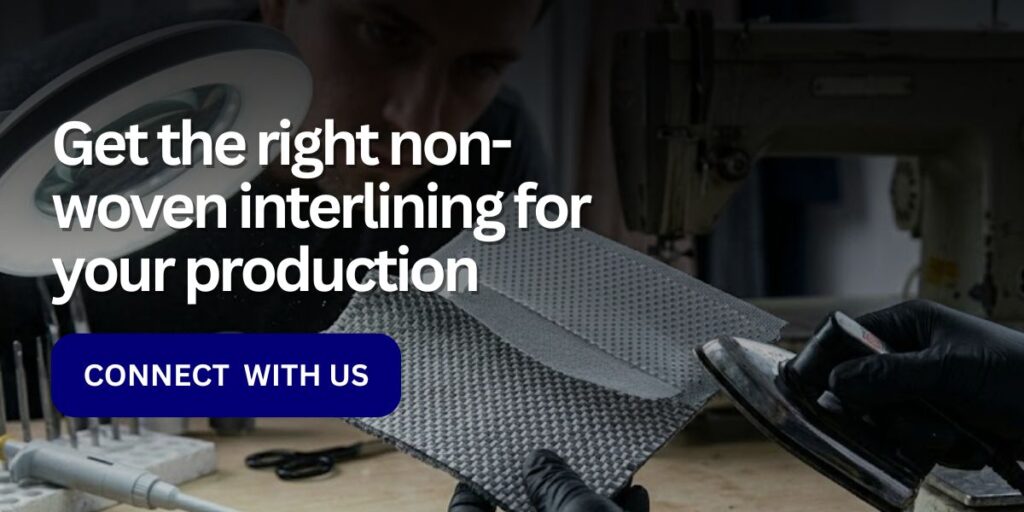
Request samples from two or three different production batches of the same product, not just one sample. Most established suppliers can provide this. When you receive the samples, check:
- GSM — weigh and calculate, compare across batches
- Dot pattern — visual check under light, same density and distribution?
- Bond strength — fuse both samples at identical parameters, compare peel resistance
- Colour — is the white the same white? Is the black the same depth?
If your supplier cannot provide samples from multiple batches, or if the samples show visible variation, that tells you exactly what your repeat orders will look like.
What inconsistency costs your production
When your interlining shifts between batches, your team ends up compensating, adjusting press temperatures, increasing dwell time, checking each roll before use. That hidden labour adds up across your production floor. It is not visible in a single order but it accumulates across a season into real productivity loss.
At Double Ghoda, buyers who have sourced from us across multiple seasons come back specifically because our batch-to-batch performance is consistent. The 30–82 GSM range, the PES double-dot coating, the 100-yard roll length, these do not shift between orders. That predictability is what makes production planning reliable.
Check Technical Expertise and Application Support
The sixth check is harder to quantify but just as important: does the supplier you are evaluating actually understand your garment and your application, or are they simply selling you a roll?
A supplier who knows the market but does not understand garment manufacturing will give you a product specification. A supplier who understands how non woven interlining is used in collar construction, cuff applications, and light garment front fuse will give you the right product for your specific production, and will be able to advise you when your specification is off.
What good supplier knowledge looks like
When you tell a knowledgeable supplier that you are producing formal shirts with spread collars and need interlining for the collar and collar stand, they should immediately ask: what is your outer fabric weight? What is your fusing press type, flat-bed or continual? What wash resistance are you targeting? The answers to those questions determine the correct GSM and coating for your application.
If your supplier quotes you a price without asking any of these questions, they are selling you a roll, not solving your production requirement.
The application fit question
Non-woven interlining is not one product, it is a range of products across GSM, coating weight, and adhesive type. The right specification for a formal shirt collar is different from the right specification for a women’s structured blouse front, which is different again from light kurta front reinforcement.
Why this matters more than price
The per-metre cost difference between the right non-woven interlining and the wrong one is small. The cost of that wrong specification showing up in your finished garments, rejects, rework, customer complaints, is significantly larger. When we advise our buyers on the right specification before they order, that guidance reduces your production risk in a way that does not show up in a price comparison.
We supply non woven fusible interlining to garment manufacturers across India, collars, cuffs, shirt plackets, women’s wear and light structured garments. Our non woven interlining fabric range covers 30–82 GSM in white, black and charcoal, in 100-yard rolls, MOQ 1,000 metres. If you tell us your garment type and outer fabric, we will give you the right GSM and coating recommendation before you place your first order.
Link of related Articles
- Lightweight Interlining vs. Heavyweight Interlining
- A Beginner’s Guide to Interlining
- Choosing the Right Interlining