
Before you even try it on, you’ll notice that a well-made sherwani or a well-tailored blazer holds its shape. Even after being worn and dry cleaned a dozen times, the silhouette remains sharp, the collar does not collapse, and the front does not sag. Such a structure is not created by chance. It originates from what is concealed within the garment, which is nearly always a woven interlining for heavy formal wear.
When purchasing fabric for suits, sherwanis, bandgalas, or formal coats, knowing why woven construction is important and when it makes sense to choose it over a lighter option can help you avoid purchasing clothing that looks fantastic on day one but falls short on day thirty. Now let’s get started.
Table of Contents
- Why Heavy Formal Garments Need the Right Support
- What Gives Woven Interlining Its Strength and Stability?
- Woven Interlining Benefits for Suits, Coats and Formal Jackets
- When Should You Choose Woven Over Non-Woven Interlining?
- What to Check Before Choosing an Interlining
- Our Woven Interlining Range at Double Ghoda
Why Heavy Formal Garments Need the Right Support
There are many expectations associated with wearing heavy formal attire. Throughout hours of wedding events, a sherwani must maintain a polished appearance. Throughout the entire workday, a structured suit must maintain its shoulder and chest lines. A woolen overcoat must maintain its shape for the duration of the winter. The outer fabric by itself doesn’t cause any of that.
Fashion fabric is pliable and soft on its own. It is comfortable to wear because of this, but it is also incapable of maintaining a distinct shape on its own. The purpose of interlining, the hidden layer that lies between the lining and the fashion fabric, is to give the garment the body and stability that the outer cloth is unable to supply on its own.
For heavy, structured garments, the interlining has to do more than just add a bit of stiffness. It needs to:
- Hold its shape through repeated wear, movement and dry cleaning
- Resist stretching, sagging or distorting under the weight of embroidery, embellishment or heavy outer fabric
- Support large panels like a full suit front or sherwani body evenly, without weak spots
- Maintain a clean silhouette that doesn’t go soft or lumpy over time
This is the point at which selecting a different kind of interlining fabric becomes important. Simple, affordable interlining is often sufficient for lighter clothing. Heavy formal attire isn’t able to. The demand for a tailored coat or a sherwani front is simply too great for a thin base layer, which is why Indian garment factories rely so heavily on one type of construction: woven.
What Gives Woven Interlining Its Strength and Stability?
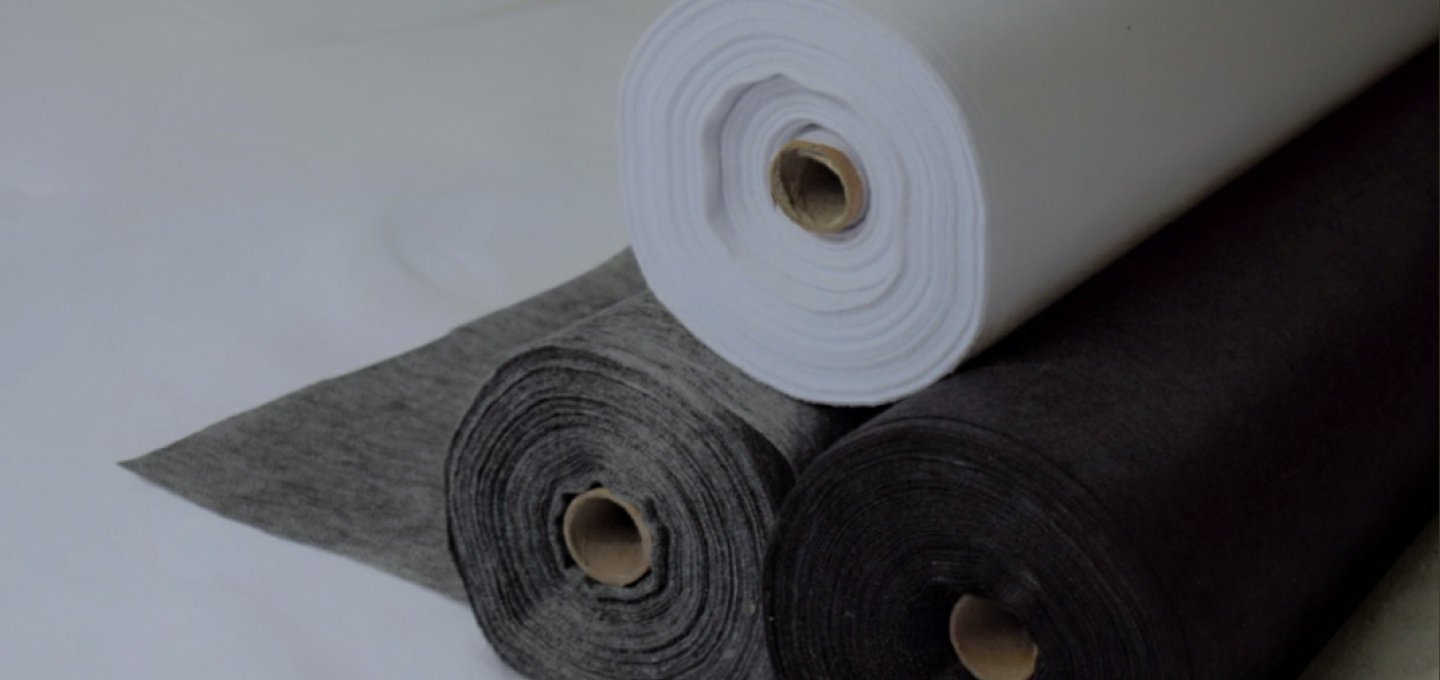
The fabric’s construction ultimately determines the solution. Yarns are interlaced in two directions to create a woven fusible interlining, with the warp running lengthwise and the weft running crosswise. A true woven fabric has this interlaced structure and behaves very differently from fabrics created by merely joining fibers.
Here’s why that construction matters for heavy formal wear:
It has a genuine grain. This construction has the same type of grain structure as your fashion fabric because the yarns run in two constant directions. As a result, it maintains its dimensions rather than changing shape and moves and behaves more predictably during cutting, sewing, and pressing.
It resists tearing and stretching. Compared to a fiber-bonded substitute, woven fabric has substantially greater tensile and tear strength due to the interlocked yarn structure. That strength prevents the interlining from deforming under the weight of the outer fabric or embroidery on a large panel, such as the sherwani body or suit front.
It bonds evenly across large surfaces. A thermoplastic adhesive coating, typically a polyamide (PA) coating, is applied on top of the woven base using a scatter or double-dot technique. During the fusing process, this adhesive melts under pressure and heat, creating a long-lasting bond with the fashion fabric. Instead of leaving weak spots near the edges, a double-dot coating pattern helps the interlining bond consistently across a large panel by spreading the adhesive more evenly across the surface than a single-dot application.
It maintains its structure after dry cleaning. Over the course of its lifetime, heavy formal clothing especially that worn for ethnic occasions undergoes numerous dry cleanings. Compared to a lighter, fiber-bonded interlining, a woven base with an evenly applied adhesive coating withstands that cycle much better.
Put simply, this kind of interlining behaves like a real fabric because it is one, and that’s exactly the kind of dependable base a heavy, structured garment needs underneath it.
Woven Interlining Benefits for Suits, Coats and Formal Jackets
So what does this actually mean for the finished garment? Here’s how the properties of this construction translate into real benefits for structured formal wear.
| Garment Feature | How Woven Interlining Helps |
| Chest and shoulder shape | Provides consistent support across the panel, holding the suit’s silhouette through wear |
| Front panel structure | Prevents sagging or bagging on large, full-front pieces like sherwanis and coats |
| Collar and lapel crispness | Keeps edges sharp and defined instead of going soft |
| Drape and movement | Woven construction moves more naturally with the body compared to stiffer alternatives |
| Durability through dry cleaning | Resists delamination and shape loss across repeated cleaning cycles |
| Embroidery and embellishment support | Handles the added weight of heavy ethnic detailing without distorting |
This construction is the norm for structured formal wear throughout India’s garment trade, in large part because of its strength and organic drape. It provides manufacturers with a base that is sturdy enough to maintain shape without making the final product feel uncomfortable or stiff.
Think about the specific garments this applies to:
- Suits and blazers need a strong woven base across the chest and front panels to hold their tailored shape through a full day of wear.
- Sherwanis and bandgalas, which carry heavier fabric and often embroidery, need a woven base strong enough to support that weight across the full front body.
- Formal coats and overcoats need interlining that won’t sag or lose shape over an entire season of use.
- Safari suits and structured jackets need enough body to hold their form without feeling overly stiff.
In each of these situations, the woven layer beneath the garment performs the structural work while the outer fabric does the visual work. The garment just functions as intended when that inner layer is correct.
When Should You Choose Woven Over Non-Woven Interlining?
This is one of the most common sourcing questions garment factories ask, and the honest answer is that it depends entirely on the garment part you’re working with. Woven and non-woven interlining aren’t competing products they’re built for different jobs.
Choose a woven base when:
- You’re building formal coats, bandgala jackets, sherwani panels, and body suit fronts.
- The item of clothing has a thick outer layer, embroidery, or decoration.
- Over its lifetime, the piece will undergo numerous dry cleanings.
- The interlining must maintain a large surface area uniformly and without any weak spots.
Choose non-woven interlining when:
- You’re working on smaller pieces like pocket facings, collars, cuffs, and plackets.
- Instead of complete structural rigidity, the application requires lighter, more cost-effective support.
- For that specific garment part, full body fusing is not necessary.
Here’s a quick side-by-side to keep in mind while you’re sourcing:
| Factor | Woven Interlining | Non-Woven Interlining |
| Construction | Interlaced yarns, true fabric grain | Bonded fibre web |
| Strength | High tensile and tear strength | Moderate — enough for small parts |
| Best suited for | Suits, blazers, sherwanis, heavy formal wear | Collars, cuffs, plackets, lighter garments |
| Shape retention | Excellent, holds structure over time | Adequate for smaller, less stressed parts |
| Typical garment role | Full-body or full-panel structural support | Precision stiffening of specific small parts |
In reality, the majority of clothing factories use both, albeit for different components of the same garment. For instance, a sherwani might have a lighter non-woven grade for the collar and a heavier woven interlining throughout the entire front body. It’s important to match the appropriate interlining fabric to the actual functions of each component of the garment rather than choosing a single type for your entire production line.
What to Check Before Choosing an Interlining
Before you commit to a bulk order, it’s worth running through a short checklist. Getting this right upfront saves you from bonding issues, shape problems or reorders down the line.
- Identify the garment part and its structural demand. Full-front panels need heavier woven support. Small parts like collars and cuffs can usually work with a lighter grade.
- Match the interlining weight to your fashion fabric. A heavy outer fabric needs a correspondingly strong interlining underneath it, or the two layers won’t behave consistently once fused.
- Consider the garment’s care requirements. If the finished piece will be dry-cleaned repeatedly which is typical for formal and ethnic occasion wear the interlining needs to hold its bond through that cycle without delaminating.
- Check the coating type and how it’s applied. A well-distributed adhesive coating, like a double-dot pattern, bonds more evenly across large panels than a coarser single-dot application.
- Confirm consistency across your supply. Structured garments depend on uniform GSM, hand-feel and coating from batch to batch. Inconsistent interlining between production runs shows up as inconsistent quality in the finished garments.
- Run a test fuse before a full production run. A quick swatch test on your actual fashion fabric tells you far more than a spec sheet ever will. It’s the simplest way to confirm the pairing works before committing to a bulk order.
Running through these points before you place an order is a small step that prevents a lot of downstream headaches on the factory floor.
Our Woven Interlining Range at Double Ghoda
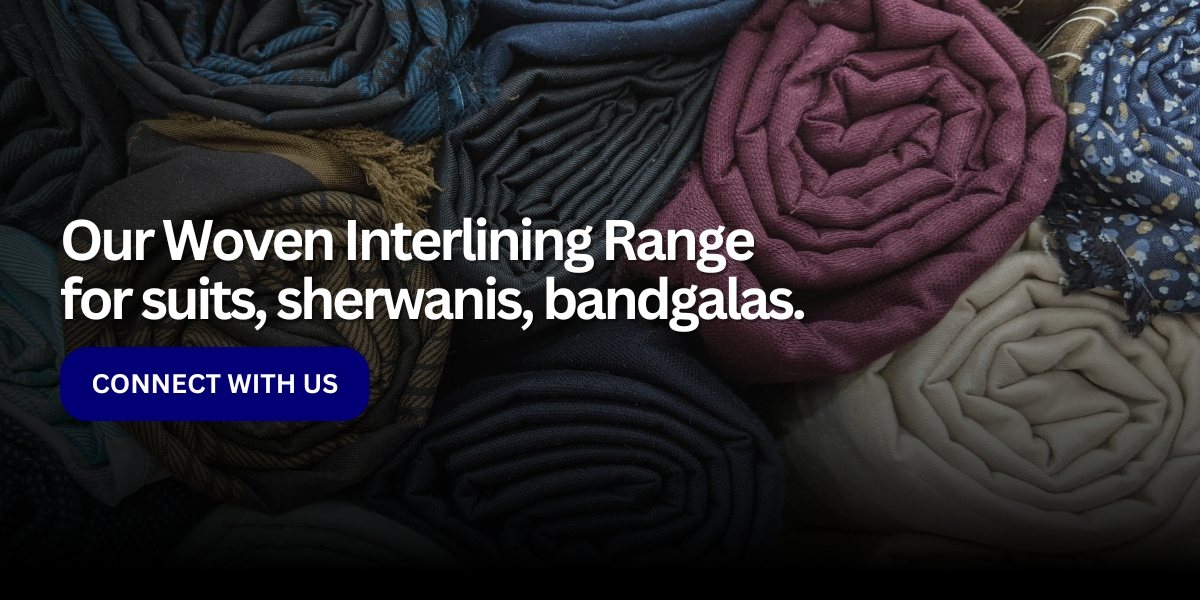
At Double Ghoda, woven fusible interlining has been a core part of our supply to garment manufacturers across India for years. We understand that heavy formal wear whether it’s a sherwani, suit, bandgala or formal coat requires more than basic fabric support. These garments need the right balance of structure, stability and drape to maintain their shape through tailoring, embroidery, repeated wear and, in many cases, dry cleaning. That’s why we’ve developed our woven interlining range with the specific demands of structured and formal garments in mind.
| Garment | Typical Weight Range | What It Needs From the Interlining |
| Sherwani | Heaviest woven grade in our range | Maximum body to hold a full-front panel through embroidery and long wear |
| Suit or blazer | Mid-to-heavy woven grade | Firm chest and shoulder shape with enough drape to stay comfortable |
| Bandgala / Nehru jacket | Heavy woven grade | Strong shape retention through repeated dry cleaning at events |
| Formal jacket | Medium-to-heavy woven grade | Structured front panels without an overly stiff hand-feel |
| Safari suit | Medium woven grade | Enough body for a tailored look without excess weight |
| Woollen overcoat | Heaviest woven grade | Full structural support that holds up across an entire winter season |
Additionally, most generic interlining suppliers don’t regularly carry the heavier end of the weight spectrum, which is why we specifically stock it. Our selection reflects the fact that Indian ethnic formal wear simply requires more fabric than international standard clothing.
A few things we hold ourselves to on every order:
- Before being shipped, each roll is measured and checked to make sure it matches your order.
- A grade that works for one production run performs the same way on the next because GSM, hand-feel, and coating remain constant from one delivery to the next.
- OEKO-TEX® Standard 100 certification and testing for hazardous materials are features of our woven range.
With a minimum order of 1,000 meters, we serve as a wholesale supplier to clothing brands, formal wear wholesalers, and garment factories. We also ship to Surat, Delhi NCR, Mumbai, Ludhiana, and other Indian garment manufacturing hubs. Contact our staff if you’re unsure which grade is best for your item of clothing; we’ll be pleased to discuss your fabric and construction requirements and direct you toward the appropriate specification.
Frequently Asked Questions
Why do suits and sherwanis have woven interlining rather than non-woven?
Compared to non-woven fabric, woven interlining has a much higher tensile strength and better shape retention because it is constructed from interlaced yarns. The weight of heavy outer fabric and occasionally embroidery is supported by full-front panels on suits and sherwanis, which require a base sturdy enough to support that structure uniformly across a sizable surface without sagging or warping.
Does a garment with woven interlining feel stiff?
Not when the garment and weight are properly matched. There is a large GSM range for woven interlining, and selecting a grade appropriate for your fashion fabric provides structure without feeling unduly stiff. A lightweight formal jacket requires a lighter woven grade than a heavily structured sherwani, and the final product’s comfort depends on the match.
Can woven and non-woven interlining be used together in the same garment?
Yes, and it’s actually the standard approach for most structured formal wear. Factories typically use a heavier woven interlining across the main body the suit front or sherwani panel and a lighter non-woven grade for smaller parts like collars and cuffs where full structural rigidity isn’t needed.
How do I know which weight of woven interlining to choose?
The right weight depends on the garment part and how much structure it needs to hold. Full-front panels on heavy ethnic formal wear typically need a higher weight range than a standard blazer or formal jacket. The safest approach is to check with your supplier and run a test fuse on your actual fashion fabric before committing to a bulk order.
Link of related Articles
- Lightweight Interlining vs. Heavyweight Interlining
- A Beginner’s Guide to Interlining
- Choosing the Right Interlining