
Choosing the wrong lining weight is one of those mistakes that shows up only after the garment is stitched and finished, and by then, reversing it comes at a cost.
For garment manufacturers, formal wear wholesalers, and tailoring units producing suits, blazers, and sherwanis at scale, polyester lining fabric selection is not just a finishing decision. It directly affects drape, durability, comfort inside the garment, and how cleanly the final product presents to a buyer or end customer.
This guide covers the full GSM spectrum, from 55 GSM to 85 GSM, what each weight does in a real garment, how to match lining to garment type, and what else to factor in before you place a bulk order.
Table of Contents
- What GSM Means in Lining Fabric and Why It Matters
- The Full GSM Range: 55 to 85 and What Each Weight Does
- Matching GSM to Garment Type — A Practical Reference
- Lining Construction: Satin, Jacquard, Taffeta, and Satin Dobby
- Why Lining and Fusing Must Be Chosen Together
- What to Check Before Placing a Bulk Lining Order
What GSM Means in Lining Fabric and Why It Matters
GSM stands for grams per square metre. It is the standard measure of fabric weight, and in polyester lining fabric, it directly determines how the lining feels, drapes, and holds up inside a garment over time.
A lower GSM lining is lighter, more fluid, and moves freely with the outer shell. A higher GSM lining has more body, handles heavier outer fabrics better, and adds internal structure to the garment without bulk.
The confusion for most manufacturers is that there is no single correct GSM, the right choice depends on four things: the outer fabric weight, the garment type, the fusing weight already applied, and in the Indian market specifically, whether the end use is ethnic formal or Western formal.
A sherwani made from 400 GSM brocade needs a fundamentally different lining decision than a slim-fit Western blazer in 250 GSM suiting cloth. Getting this wrong does not always show up as an obvious defect. It shows up as the lining that wrinkles and bunches after two wears, or the garment that feels heavier than it should, or the interior that loses shape after the first dry clean.
Understanding the GSM range is how you make that decision correctly the first time.
What polyester lining fabric is used for: Lining is the interior finishing layer in structured garments, suits, jackets, blazers, sherwanis, bandhgalas, and achkans. Its purpose is to hide the internal construction (fusing, tailoring seams, interlining layers), provide a smooth surface against the wearer’s clothing or skin, and finish the garment’s interior to a standard that matches the exterior.
It is not a structural layer. That role belongs to the fusible interlining underneath. Lining and interlining are different products with different functions, and both need to be selected correctly for the garment to perform as built.
The Full GSM Range: 55 to 85 and What Each Weight Does
Our polyester lining range runs from 55 GSM to 85 GSM. Here is how each weight zone performs in practice, not in theory.
- 55 GSM — Lightweight and Fluid
This is the lightest functional lining weight in the range. 55 GSM has very low internal resistance, a smooth almost silk-like surface finish, and excellent drape against light outer fabrics.
Best for: Light summer jackets, unstructured blazers in thin suiting (under 200 GSM), casual bandhgala jackets, and kurtas that need a light interior layer without adding stiffness or weight.
Where it falls short: 55 GSM does not provide enough body to sit flat against a heavy fused interlining surface. Over time, it shifts and bunches behind the fusing layer, creating visible wrinkling at the chest and front panels. It is not suitable for structured suits or heavy ethnic formal wear.
- 60–65 GSM — Mid-Light Range
A step up from 55 GSM with slightly more fabric body and resistance. This range handles a broader set of garments without crossing into medium-weight territory.
Best for: Formal shirts with interior lining panels, light ethnic jackets, sleeveless jackets and vests, collar and cuff backing where a lining layer is used instead of non-woven interlining.
Still a lighter-end product. Not the first choice for structured formal wear, but well-suited for garments where the outer fabric is thin and overall garment weight must stay low.
- 70–75 GSM — The Most Versatile Range
This is where most general formal wear manufacturing lands, and for good reason. 70–75 GSM handles a wide range of outer fabrics, from mid-weight suiting to heavier knit jackets, without being too heavy for lighter ethnic formal applications.
Best for: Formal suits, mid-weight blazers, standard sherwanis, and general formal wear production across both ethnic and Western categories.
For units producing a mixed range, suits, blazers, and lighter ethnic wear, 70–75 GSM reduces SKU complexity without compromising on either end of the product mix. It is a practical default for mixed-format production.
- 80–85 GSM — Heavyweight Performance
This is the weight used for the heaviest formal applications in the Indian market. 85 GSM polyester lining fabric has enough body to balance a heavy outer shell, sit flat against a thick fused interlining, and hold its position through repeated dry cleaning, folding, and use.
Best for: Heavy sherwanis, especially embroidered or brocade-heavy pieces above 300 GSM, structured Western suits with heavy outer fabrics, achkans and long-format ethnic formal coats, and any garment where the outer fabric weight is at the heavier end of the range.
The trade-off: Heavier lining adds marginally to the total garment weight. In very hot weather, this can add interior warmth. 85 GSM is specifically for heavy formal wear, it is not a universal upgrade, and using it in lightweight garments is unnecessary.
Matching GSM to Garment Type — A Practical Reference
The table below is a working reference for production planning. Final selection should always account for the specific outer fabric being used, the fusing weight applied, and the stitch construction of the garment.
| Garment Type | Outer Fabric Weight | Recommended Lining GSM |
| Unstructured casual blazer | Under 200 GSM | 55–60 GSM |
| Formal Western suit | 250–300 GSM suiting | 70–75 GSM |
| Structured suit jacket | 300+ GSM | 75–80 GSM |
| Bandhgala / Indian blazer | Medium to heavy | 70–80 GSM |
| Sherwani (light fabric) | Light brocade or crepe | 65–70 GSM |
| Sherwani (heavy brocade or embroidered) | 300+ GSM brocade | 80–85 GSM |
| Achkan / formal ethnic coat | Heavy | 80–85 GSM |
| Sleeveless jacket or vest | Light to mid | 55–65 GSM |
| Safari suit | Mid-weight | 65–70 GSM |
For the Indian market specifically: Surat, Ludhiana, Delhi, and Kolkata garment units work with heavier outer fabrics than international equivalents. Brocades and embroidered fabrics running 350–500 GSM are standard in ethnic formal manufacturing. International lining standards are calibrated for lighter Western fabrics, they under-specify for what Indian ethnic formal wear actually requires. This is why the 80–85 GSM end of our range moves heavily in ethnic formal hubs, particularly across Gujarat.
Top-selling colours across the range: Black, blue, white, and off-white. These reflect the dominant colour range in Indian formal wear. Black lines the largest volume of dark suits and sherwanis. White and off-white are used in lighter sherwanis, ivory bandhgalas, and cream-toned ethnic formal wear. Blue moves consistently year-round for navy suits and blue-toned sherwanis.
Colour matching between lining and outer fabric matters more than many manufacturers initially account for, especially in garments where the lining is partially visible at cuffs, collars, and front openings.
Lining Construction: Satin, Jacquard, Taffeta, and Satin Dobby
GSM is one axis of selection. The construction, the weave type, is the other. Two linings at the same GSM can behave very differently depending on how they are built.
- Satin
Smooth, high-sheen finish. Excellent for interior presentation in premium suits and jackets where the lining is visible when the garment is opened or laid flat. The surface slides cleanly against the wearer’s inner clothing, reducing friction. Available across the full GSM range.
Satin is the standard choice when a clean, uniform interior finish is the primary requirement and pattern or texture is not specified.
- Jacquard
Our top-selling lining construction, and the preferred choice among large-scale brands and manufacturers across India.
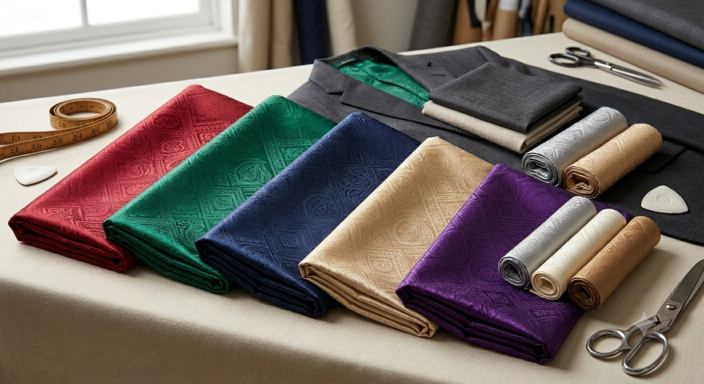
Jacquard has a woven pattern built directly into the fabric structure, not printed on, not applied after weaving. This gives it a structured appearance, slight additional body beyond its GSM, and a premium interior finish that communicates quality at the moment the garment is opened. Buyers and end customers associate the jacquard interior with the premium formal wear segment.
For brands and manufacturers supplying the formal wear market, sherwanis, suits, branded jackets, the jacquard lining is a marker of product tier. It is the reason many large brands specify jacquard for their interior lining even when a satin lining would be functional.
- Satin Dobby
A middle ground between satin and jacquard. The dobby weave creates a subtle textured or geometric pattern within the fabric while retaining a smooth surface feel and satin-like appearance.
Popular for formal sherwanis where full jacquard may feel too elaborate for the garment’s outer fabric, but plain satin appears too basic. Also used in suits where a slight pattern is preferred without the density of a full jacquard.
- Taffeta
Crisp, slightly stiff construction with a faint rustle. Used in garments where the lining is meant to hold shape on its own, structured skirts, lehengas, formal coats. Less common in suit and blazer applications but used in specific ethnic formal contexts where a rigid interior layer is part of the garment’s intended structure.
For suits, blazers, and sherwanis: Jacquard and satin polyester lining are the primary choices for the majority of your production. Taffeta and satin dobby serve specific garment types within the range.
Why Lining and Fusing Must Be Chosen Together
A common production mistake is selecting lining weight independently of interlining weight. These two layers sit adjacent inside the garment and their weights, construction, and care properties need to be matched, or problems follow.
Too-light lining over heavy fusing: The lining cannot hold its position across the fused surface. It wrinkles or bunches behind the fusing layer, becoming visible through the garment’s opening over time.
Too-heavy lining under light fusing: The lining adds weight and rigidity that the interlining was not designed to support. The garment feels stiff in the wrong places, particularly at the chest and front panel.
Mismatched shrinkage rates: If lining and interlining respond differently to heat or cleaning, the garment distorts after its first dry clean. The fused layer stays fixed; the lining contracts or expands relative to it. This creates permanent puckering at seam lines.
Practical pairing guidance:
| Fusing Weight | Matched Lining GSM |
| 55–70 GSM woven interlining | 55–65 GSM lining |
| 80–100 GSM woven interlining | 65–75 GSM lining |
| 111 quality / 120–140 GSM woven interlining | 75–85 GSM lining |
| Non-woven 30–50 GSM | 55–65 GSM lining |
These pairings are based on how the layers perform together in production, not theoretical weight ratios.
Our woven fusible interlining and polyester lining range are both built for Indian ethnic formal and Western formal manufacturing. Manufacturers who source both from us get combinations that have already been aligned for production performance. There is no guesswork in the pairing.
One more point on fusing: Our woven fusible interlining uses PA double-dot coating, which fuses faster and bonds more securely than standard single-coat alternatives. When paired with the right lining weight, the fused surface stays flat, the lining sits cleanly over it, and the garment holds its shape through use and cleaning. The lining is the visible layer, the fusing underneath is what keeps it looking right.
What to Check Before Placing a Bulk Lining Order
For manufacturers evaluating a new lining supplier or reviewing existing supply, these are the checks that matter at trade scale. These are not quality-lab tests, they are practical production assessments.
- Metre Accuracy
Short rolls that read as full rolls are one of the most consistent pain points in the lining supply chain. A roll labelled as 45 metres should deliver 45 metres. Short metres create mid-run shortfalls that disrupt cutting schedules and increase per-unit cost without any visibility until the roll runs out.
Our polyester lining fabric rolls are supplied at accurate 45-metre lengths. Buyers who have switched to us from other suppliers notice this immediately, not because it is unusual in principle, but because accurate metres at consistent roll lengths are not universal in practice.
- Colorfastness
Does the colour hold after dry cleaning or wet contact? Poor colorfastness transfers onto outer fabric through heat or pressure, particularly a problem in humid storage conditions or when finished garments are packed tightly. Black and navy linings are the most common offenders when colorfastness is not verified at source.
- Dimensional Stability
Does the lining retain its cut dimensions after light heat exposure during pressing? Lining that shrinks slightly under the iron shifts position inside the garment during stitching, creating off-seam finishing that cannot be corrected without recut.
- Surface Consistency Across the Roll
Is the weave and sheen consistent between metre 1 and metre 45? Construction variation across the roll shows up as tonal differences in the finished garment, particularly visible in satin lining where light reflection changes with weave density.
- Seam Slip Resistance
Satin lining constructions are prone to seam slippage if the weave is too open. Check whether the fabric holds its seams under tension, particularly at high-stress points, sleeve seams, shoulder seams, and side seams in fitted sherwanis.
- Smooth Finish Against Interlining
The lining should slide freely over the fused interlining surface when the garment is worn. Rough or high-friction lining creates resistance and discomfort, particularly in full-length sherwanis and structured suits worn in warmer conditions. This is a wearing-experience check, not just a visual one.
On minimum order quantity: We supply wholesale only, with a minimum order of 1,000 metres. For production planning, a standard 45-metre roll covers approximately 12–18 suit jackets depending on cut and lining area. Factor this against your run length before placing.
Bringing It Together
The GSM decision for polyester lining is straightforward once you work from the garment out, not from a default number in.
Start with the outer fabric weight. Match it to the right GSM range using the reference table above. Cross-check against the fusing weight you are already running. Select the construction, jacquard for premium interior presentation, satin for a clean standard finish, taffeta or dobby for specific applications. Confirm the colour against the outer fabric at the garment’s visible openings.
That is the full decision, made correctly.
For the Indian ethnic formal market, particularly in Surat and across North India, the heavier end of the range (75–85 GSM) performs consistently because the outer fabrics demand it. Do not let international standard references pull your selection lighter than the garment requires.
For bulk inquiries on polyester lining fabric, woven fusible interlining, and garment accessories, contact Double Ghoda directly. Minimum order is 1,000 metres. We supply wholesale to manufacturers in Surat, Ludhiana, Delhi, Kolkata, Chandigarh, Amritsar, and across India.
Link of related Articles
- Lightweight Interlining vs. Heavyweight Interlining
- A Beginner’s Guide to Interlining
- Choosing the Right Interlining